Democrat
Explore your elections, candidates, and representatives at the federal and state level — all in one place.
Your address is only used to find your districts. We don't store it.
Sourced verbatim from the candidate's website.
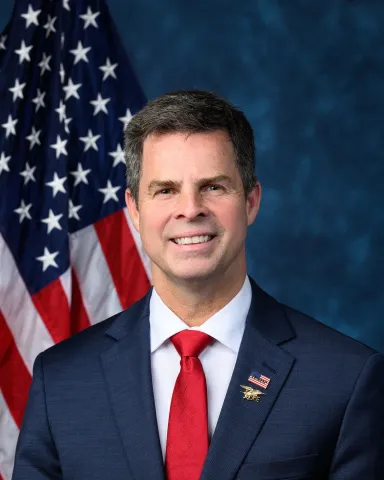
Burk was raised by a single mother who worked tirelessly to make ends meet. Determined to overcome financial hardship, he enlisted in the U.S. Navy right after high school, serving 14 years and rising to the rank of Lieutenant Commander (O-4). During his service, he became a certified Nuclear Plant Operator and Surface Warfare Officer. He earned a Bachelor of Science in Quantitative Economics from the United States Naval Academy and later an MBA from the University of Oxford. He considers himself more of an activist than a politician and is highly passionate about restoring society to greater community involvement. In 2022, he left a lucrative career in the tech industry to give back through public education, and has since taught 5th, 6th, and 7th grade.
Sourced verbatim from the candidate's website.
We will need AI to help get us out of this thirty-seven trillion dollar debt. Although in the short-term AI will certainly lead to job loss, we must lean into AI for job creation and GDP growth. AI has the potential to unlock significant benefits, including driving economic growth and efficiency, improving healthcare and education, solving global challenges like climate change, and enhancing creativity. While some jobs may be displaced, AI can also offer opportunities for job creation in sectors we can't yet fully envision. Additionally, AI can increase accessibility, improve decision-making, and pave the way for innovations in numerous fields, making it a transformative force for societal progress.
Had the ultra-wealthy been just a little more subtle, they might have gotten away with it. But as the saying goes, "You get greedy, you get caught." Through Citizens United and other manipulations of our representatives, along with recent attempts to raise the national debt by $5.7 trillion—all while stripping the poor and middle class of basic needs like food and healthcare—they've shown they'll chase every last dollar, even if it pushes our nation to the brink. The problem is not just that the rich are getting richer while the middle class withers, it's that this is happening at an accelerated rate! We must fight back.
In the late 1950s the CEO of a major corporation made 20 times more than the average employee. Today it's 300 to 1000 times more. - During the COVID-19 pandemic, over 500 new billionaires were created in 500 days. - Right now, the top 0.1% of Americans own more wealth than the bottom 90%. - Just three people (Musk, Bezos, and Zuckerberg) own more wealth than the bottom 50% of the entire country. - In the late 1950s, the typical household spent about 10% of its income on housing—today, it's about 34%, yet labor productivity (output per hour worked) has increased by 2.5 times! That last one has a lot of numbers, but the point is important: corporations are getting way more profitable, yet they're not increasing wages! WTH…
The New Deal (1933-'39) ushered in a golden era for the American middle class, laying the foundation for unprecedented economic security and mobility. Through policies like Social Security, labor protections, and public infrastructure projects, the government invested in the prosperity of everyday citizens. The post-World War II boom further cemented this progress, with the GI Bill expanding homeownership and higher education, strong unions securing fair wages, and manufacturing jobs providing stable careers. Economic growth was widely shared, and for much of the mid-20th century, a single factory job income was enough to support a family, buy a home, and retire comfortably. The American Dream felt attainable because policies ensured that hard work was rewarded with fair pay, benefits, and protections. However, by the 1980s, the pillars supporting the middle class began to erode. Deregulation, tax cuts favoring the wealthy, and the decline of labor unions weakened worker protections and allowed wages to stagnate despite rising productivity. The outsourcing of manufacturing jobs and the shift to a service-based economy led to less stable employment. Meanwhile, the cost of housing, healthcare, and education soared, making it harder for families to maintain the same standard of living. Policies that once prioritized broad prosperity were replaced by those that concentrated wealth at the top, leading to historic levels of inequality.